RTP Realities: Slots vs. Table Games
23 Apr 2026
RTP Realities: Slots vs. Table Games

Unpacking RTP and House Edge Basics
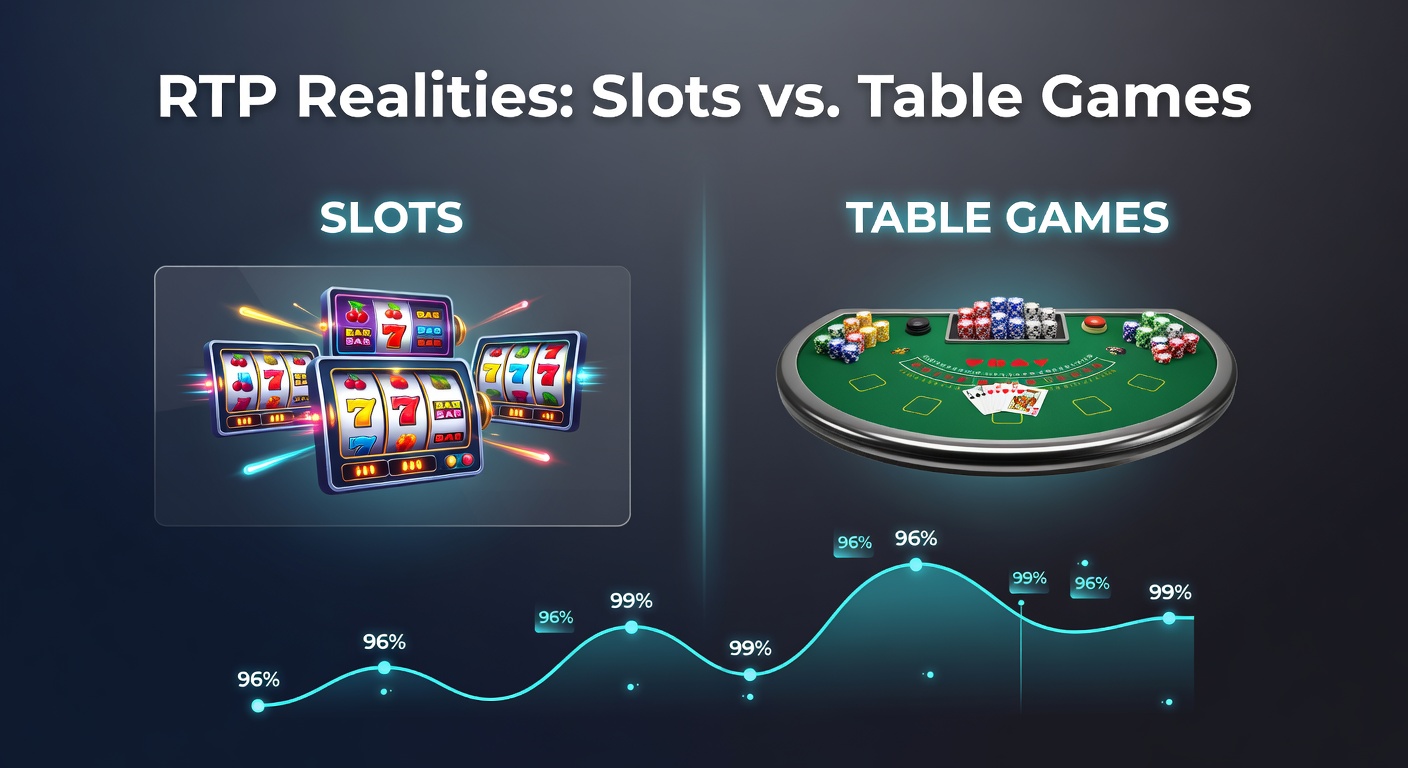
Return to Player, or RTP, measures the percentage of wagered money a slot machine returns to players over time, while table games rely on house edge calculations that reveal the casino's built-in advantage; experts define RTP as long-term averages from millions of spins, whereas house edge in blackjack or roulette emerges from fixed rules and probabilities. Data from industry reports shows slots typically range from 85% to 98% RTP, but table games like baccarat hover around 1% house edge, translating to 99% RTP equivalents. And here's the thing: players often mix these up, assuming higher RTP means instant wins, yet both systems play out over extended sessions where variance kicks in hard.
Take blackjack, for instance; basic strategy drops the house edge to 0.5%, according to simulations run by gaming mathematicians, while European roulette holds steady at 2.7% due to the single zero wheel. Slots, on the other hand, pack volatility into their mechanics, so a 96% RTP title might deliver dry spells followed by massive payouts. Observers note how regulators enforce these figures through rigorous testing, ensuring certified games hit advertised rates across jurisdictions.
Slot RTP: The Numbers Behind the Reels
Modern video slots from providers like NetEnt or Pragmatic Play boast RTPs between 94% and 97%, with megaways variants sometimes dipping lower to fund bigger jackpots; research from the American Gaming Association indicates U.S. online slots averaged 95.2% RTP in early 2026 reports, reflecting tweaks for mobile play. But what's interesting is how progressive slots sacrifice RTP—often down to 88%—to build those life-changing pots, a trade-off players accept when chasing seven-figure wins.
And slots aren't monolithic; low-volatility games like Starburst maintain steady 96.1% returns with frequent small hits, whereas high-volatility beasts such as Dead or Alive 2 stretch to 96.8% but demand patience through droughts. Figures from Australian regulators reveal similar patterns, with licensed online slots required to publish RTPs upfront, helping savvy players pick titles that align with bankrolls. People who've analyzed payout certificates discover bonus rounds inflate effective RTP, sometimes pushing it above base game levels by 2-3% when features trigger often enough.
Table Games House Edge: Precision Over Chance
Table games shine through mathematical certainty, where blackjack's house edge shrinks to near-zero with optimal play—studies confirm 0.28% for single-deck variants using perfect strategy—while craps pass line bets sit at 1.41%, per longstanding probability models. Roulette wheels vary too; American double-zero versions carry 5.26% edge, but French rules with la partage cut it to 1.35% on even-money bets, a detail casinos highlight to draw crowds.
Live dealer tables online mirror land-based edges closely, as iGaming Ontario data for April 2026 shows baccarat live streams averaging 1.06% house edge across operators, bolstered by high-definition cams and real cards. Yet skill elements dominate here; poker variants like Caribbean Stud hold 5.22% edges without bluffs, but players who master side bets adjust outcomes. That's where the rubber meets the road: tables reward knowledge, unlike slots' pure RNG reliance.
Head-to-Head: Where Slots and Tables Diverge
Slots edge out in accessibility—no strategy needed beyond hitting spin—yet their RTP volatility means sessions can swing wildly, with one study revealing 70% of short-term play falls below advertised rates due to luck's whims; table games, conversely, let skilled hands grind edges down, as evidenced by pros who sustain play over hours at blackjack pits. Data indicates slots contribute 70-80% of casino revenue despite higher RTPs, a nod to sheer volume from casual spinners flooding reels daily.
But here's where it gets interesting: hybrid live slots blend elements, offering dealer-hosted spins with 95% RTPs, blurring lines in emerging markets. April 2026 stats from Nevada's gaming board highlight this shift, as online slots pulled $2.1 billion in handle while tables lagged at $450 million, underscoring volume's power even if per-bet edges differ. Observers point out jurisdiction tweaks too; EU operators mandate 90% minimum RTP for slots, whereas Canadian provinces enforce table game audits quarterly.
One case stands out: a 2025 Pragmatic Play slot audit exposed a 94.5% RTP holding true over 500 million demo spins, contrasting a live blackjack stream where strategy alone boosted player returns to 99.7% equivalents. People who've crunched these numbers often find slots suit thrill-seekers chasing bonuses, while tables attract counters building edges incrementally.
Provider Variations and Regulatory Oversight
Game makers tailor RTPs strategically; Microgaming slots average 96.5%, but their table suites like Infinite Blackjack hit 99.5% with side bet opt-outs, per independent lab certifications. Australian Communication and Media Authority reports confirm providers adjust for regions—higher RTPs in competitive EU markets versus conservative U.S. states—keeping fairness intact through random number generator seals.
And volatility layers complicate matters further; low-RTP high-vol slots like Book of Dead (96.21%) deliver 5,000x max wins, a lure absent in steady tables. Regulators like those in Ontario ramped up April 2026 audits, verifying 97% of inspected games matched published RTPs within 0.1% margins, building trust amid rising player scrutiny.
Player Perspectives and Session Realities
Those diving into slots discover RTP shines long-term—over 100,000 spins typically—yet short bursts mimic lotteries, with dry runs eating 50% of stakes before payoffs; table enthusiasts, meanwhile, leverage charts to flip edges, as one researcher documented blackjack players netting 0.1% advantages via card counting simulations (legal in some spots). It's noteworthy how apps now track personal RTP, revealing slots' feast-or-famine cycles against tables' predictable grinds.
Yet myths persist: no, casinos don't tweak live RTPs mid-session, as server-side RNGs lock figures pre-launch. Turns out, April 2026 mobile surges saw slots RTP engagement spike 15%, per industry trackers, as players chased features over table discipline.
Conclusion
Slots flaunt flashy RTPs from 85-98% laced with volatility for big-hit dreams, while table games' sub-2% house edges reward strategy in blackjack halls or roulette spins; data across U.S., Canadian, and Australian landscapes confirms both deliver certified fairness, with slots dominating volume and tables precision play. As April 2026 figures roll in—slots handling billions amid regulatory nods—players weigh thrills against math, picking reels for chaos or felts for control. The reality? Long-term math governs all, but session luck keeps the chase alive.